How we work
What we use, and what we will not do
Every method below has two sides: when it is used and when it deliberately is not. That second side is rare on a garden firm’s site, and it is the only way to know beforehand what you are getting.
Closed over at most
50%
We will not build a garden that is more than half hard surface. On this ground the water has to go somewhere.
Lead time
3 to 6
Working days for a garden up to a hundred square metres, spread over two weeks.
We come back within
12mo
Anything we plant that fails to take, we replace within a year at no cost.
Six methods, and six times when not
Behind every refusal sits a reason outside us: the ground under Amsterdam, a city by-law, a provincial rule, or the question of what is left of something in four years.
Breaking the ground open to forty centimetres
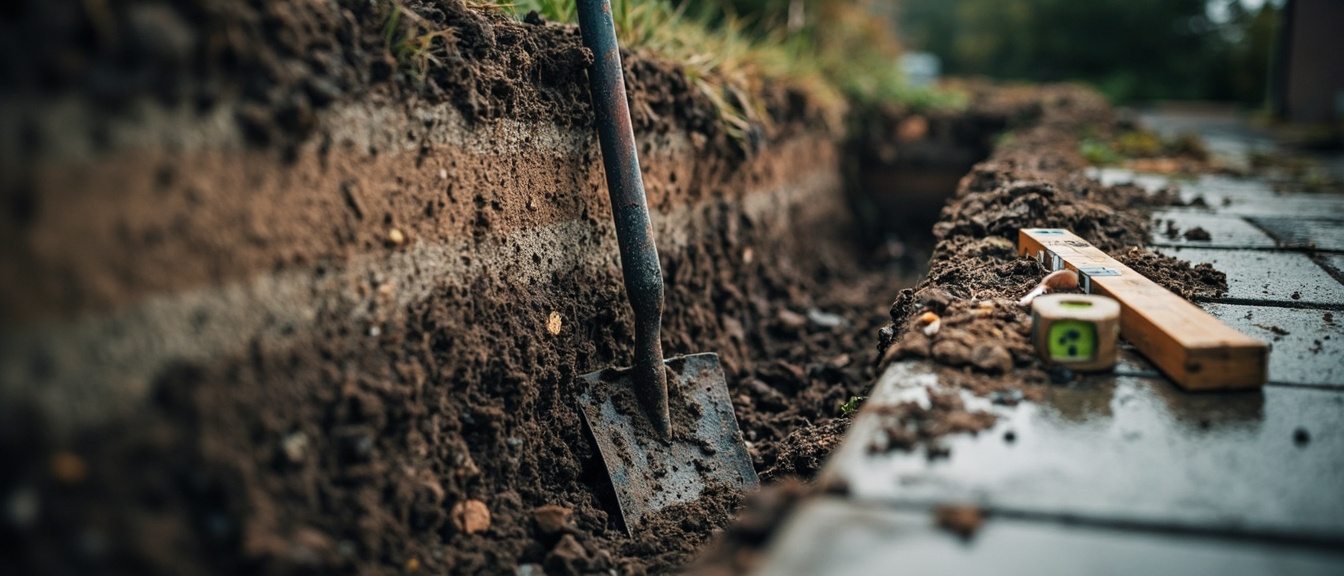
Under almost every garden in Noord sits a compacted band: from site preparation, from years under a terrace, or from machinery that once drove over it. Roots stop there and water stands on top of it. Before planting goes in, we break that band open to around forty centimetres and improve the soil with whatever the spot actually needs.
Forty and not eighty, and that is not a saving. The layer below is the poorly permeable peat and clay that keeps the groundwater where it is; dig through that and you have made a well that fills itself.
When we do not: Not under the canopy of an existing tree. The fine roots that take up water sit in the top thirty centimetres there, and a digger removes them irreversibly in an hour.
Hard surfacing, and half the garden at most
Terraces, paths and drives go on a compacted base with a laying course thick enough to be repaired later without lifting everything. Fall of at least one centimetre per metre, always away from the house, and two centimetres of clearance against the brickwork so the paving can move.
The limit we set ourselves is half. We will not close over more than half of a garden, however it is asked for.
When we do not: No more than fifty per cent hard surfacing, and no artificial grass on a garden that has to hold water. The made-up layer is the only permeable layer under these neighbourhoods; what cannot soak into it ends up in a crawl space or next door.
Weed fabric
Under a gravel path or an open surface where nothing needs to grow, fabric does its job: it keeps the gravel out of the soil and the soil out of the gravel. That is where we lay it.
When we do not: Never under a border. It holds weeds for one year and works against you afterwards: humus builds on top of it in which the same weeds root perfectly well, while the planting beneath cannot spread. In ten years there is plastic in your soil that has to come out by hand.
Raising ground level with sand
In the garden villages the garden sits on the made-up layer and settles with it while the house stays put on its piles. Raising is a normal intervention there: in thin layers, compacted, with the drainage reset so the water does not end up running towards the wall after all.
When we do not: Not in Landelijk Noord on the peat. Every cubic metre of sand added there compresses the peat further; you buy a few years and then speed the settling up. There we build light instead of high.
Removing weeds
By hand, with a brush or with hot water, and on paving with a joint brush. That takes longer than spraying, and it is built into the annual figure.
When we do not: No chemical weedkiller, anywhere, not on paving and not on request either. What you spray on a terrace washes into the made-up layer with the first rain, and in Amsterdam-Noord that is the same layer the groundwater sits in.
Trees: measure first, talk afterwards
Before anything is agreed about a tree, we measure the trunk circumference at 130 centimetres. Below 31 centimetres it falls outside the Amsterdam permit requirement and the conversation is short. Above it, the 2014 tree by-law applies, a permit is required, and a replanting obligation is normally attached.
When we do not: We do not fell without a permit and we do not fell in the breeding season. A tree felled without one does not come back by applying afterwards, and that bill lands with you and not with us.
First whether it can be done, then what it costs
Photograph the spot where the water stands. That answers half the question on its own.
The order of a job, and why it is fixed
Four stages, always in this order. A garden where the planting goes in before the drainage is a garden that gets built twice.
Measure
An hour with a tape, a level and a soil auger. Afterwards you know how deep the usable soil sits, how much fall there is from doorstep to back boundary, and where the water can go.
Draw
A scale plan with the measurements on it and the drainage line drawn in. Not pretty but usable, and revised as often as needed while nothing has been built.
Dig and dispose
Clearing, breaking the ground open to forty centimetres, laying drainage. This is the largest item on the quotation and the only one you cannot revisit later.
Lay and plant
Hard surfacing on a fall, then the planting. In that order, because a border that has had building traffic standing on it begins with a compacted layer under the roots.
Before and after
Drag the handle and see the difference for yourself
Three situations that come up constantly in this district. Under each frame is what was done and how many working days it took.
 Before
 After
After Before
 After
After Before
 After
AfterTorn between two solutions
Put both to us. We will say which of the two lasts longer on this ground, and why.
Your request
Six fields and a photo. With the area and the type of garden we can name a band before coming out; without those two, any answer is a guess.
Start with a photo
One photo from the back door showing the whole garden almost always saves a trip. Send two if you like: one of the whole and one of the spot where it goes wrong.