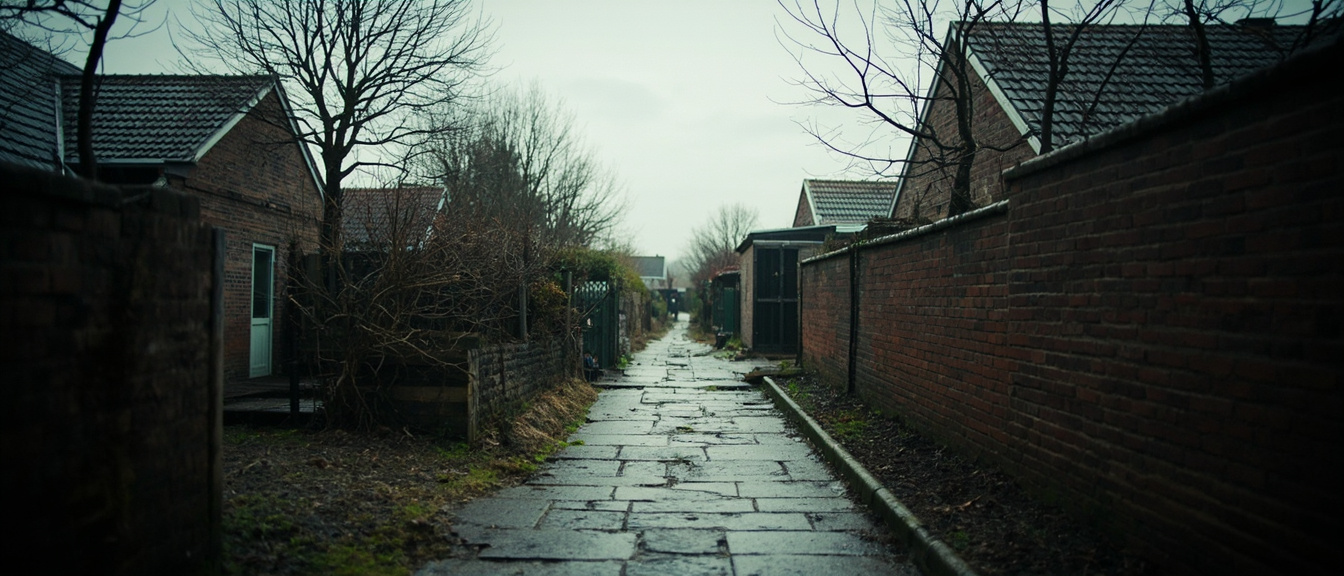
Garden villages, dike ribbons, peat meadow
A garden in Amsterdam-Noord sits on peat, and that decides everything
The house stands on piles reaching sand at twelve metres and does not sink. The garden sits on the made-up layer and does. So we start with the drainage, not with the slabs.
Closed over at most
50%
We will not build a garden that is more than half hard surface. On this ground the water has to go somewhere.
Lead time
3 to 6
Working days for a garden up to a hundred square metres, spread over two weeks.
We come back within
12mo
Anything we plant that fails to take, we replace within a year at no cost.
What happens
What we will not do, and why
A garden firm that can do everything can refuse nothing. These are the six places where we say no, and behind every no sits the ground under Noord, a city by-law, or the question of what will still be standing in four years.
Six working methods, each with the rule for when we deliberately do not use it. That second rule is what this section is for.
Breaking the ground open to forty centimetres
Under almost every garden in Noord sits a compacted band: from site preparation, from years under a terrace, or from machinery that once drove over it. Roots stop there and water stands on top of it. Before planting goes in, we break that band open to around forty centimetres and improve the soil with whatever the spot actually needs.
Forty and not eighty, and that is not a saving. The layer below is the poorly permeable peat and clay that keeps the groundwater where it is; dig through that and you have made a well that fills itself.
When we do not: Not under the canopy of an existing tree. The fine roots that take up water sit in the top thirty centimetres there, and a digger removes them irreversibly in an hour.
Hard surfacing, and half the garden at most
Terraces, paths and drives go on a compacted base with a laying course thick enough to be repaired later without lifting everything. Fall of at least one centimetre per metre, always away from the house, and two centimetres of clearance against the brickwork so the paving can move.
The limit we set ourselves is half. We will not close over more than half of a garden, however it is asked for.
When we do not: No more than fifty per cent hard surfacing, and no artificial grass on a garden that has to hold water. The made-up layer is the only permeable layer under these neighbourhoods; what cannot soak into it ends up in a crawl space or next door.
Weed fabric
Under a gravel path or an open surface where nothing needs to grow, fabric does its job: it keeps the gravel out of the soil and the soil out of the gravel. That is where we lay it.
When we do not: Never under a border. It holds weeds for one year and works against you afterwards: humus builds on top of it in which the same weeds root perfectly well, while the planting beneath cannot spread. In ten years there is plastic in your soil that has to come out by hand.
Raising ground level with sand
In the garden villages the garden sits on the made-up layer and settles with it while the house stays put on its piles. Raising is a normal intervention there: in thin layers, compacted, with the drainage reset so the water does not end up running towards the wall after all.
When we do not: Not in Landelijk Noord on the peat. Every cubic metre of sand added there compresses the peat further; you buy a few years and then speed the settling up. There we build light instead of high.
Removing weeds
By hand, with a brush or with hot water, and on paving with a joint brush. That takes longer than spraying, and it is built into the annual figure.
When we do not: No chemical weedkiller, anywhere, not on paving and not on request either. What you spray on a terrace washes into the made-up layer with the first rain, and in Amsterdam-Noord that is the same layer the groundwater sits in.
Trees: measure first, talk afterwards
Before anything is agreed about a tree, we measure the trunk circumference at 130 centimetres. Below 31 centimetres it falls outside the Amsterdam permit requirement and the conversation is short. Above it, the 2014 tree by-law applies, a permit is required, and a replanting obligation is normally attached.
When we do not: We do not fell without a permit and we do not fell in the breeding season. A tree felled without one does not come back by applying afterwards, and that bill lands with you and not with us.
Before and after
Drag the handle and see the difference for yourself
Three situations that come up constantly in this district. Under each frame is what was done and how many working days it took.
 Before
 After
After Before
 After
After Before
 After
AfterFirst whether it can be done, then what it costs
Photograph the spot where the water stands. That answers half the question on its own.
What it costs
A band per trade, and no figure with a "from" in front of it
Six items with a lower and an upper limit, all including Dutch VAT. Where those limits come from, and where the published guides contradict each other, is on the prices page.
| Trade | Including VAT |
|---|---|
| Full garden rebuild | 95 to 175 |
| Renewing paving | 70 to 120 |
| Planting with soil improvement | 45 to 110 |
| Cutting a hedge | 5 to 10 |
| Maintenance, four rounds | 4 to 9 |
| Hourly work, where a square-metre price does not fit | 68 to 82 |
If it disappoints
What happens if the garden does not turn out as you pictured it
With a garden that is not a theoretical question. Planting can fail, a terrace can settle, and a hedge can end up in the wrong place. This is what happens then.
Planting that fails to take
Replaced within twelve months of planting at no cost, provided the garden was watered through the first season according to the schedule you were given.
Paving that settles
Within two years of handover we repair settlement in work we laid ourselves, base included. Settlement of the surrounding ground falls outside that, and the quotation says so.
A design that turns out not to work
The drawing exists before anyone digs, and we revise it as often as needed while nothing has been built. After that a change becomes extra work, and you hear about it before it happens.
Who comes back
The same people who built it. We do not subcontract the work, other than tree work above the permit threshold, and that appears separately on the quotation.
Where we work
Six neighbourhoods, chosen on the share of homes that have a garden
Amsterdam-Noord has fifteen official neighbourhoods. In six of them most homes have a garden of their own; in the other nine the green space is shared. That difference decides which pages exist here.


What people call about
Five trades, in the order people think about them
From the garden that starts again from nothing, through the parts it is made of, to the work that comes round every year.
 Garden renovationThe whole garden out and back in, with a scale drawing before the first spade goes in.
 Paving and terraceWhy a terrace goes out of level here, and what has to sit underneath to stop it.
 Planting and bordersWhat takes on wet peat soil, and what is gone again within three years.
 Pruning and hedgesHedges, shrubs and trees, and what does and does not need a permit in Amsterdam.
 Garden maintenanceFour fixed rounds a year, with what happens in each of them written down.
Questions that come up often here
Can I explain what I want in English?
Yes. The call is answered in English if you start in English, and WhatsApp works just as well. For a garden a photo settles more than either of us finding the right word: shoot from the back door with the whole garden in frame, and if there is a spot where water stands or paving has dropped, send that as a second picture.
Why do you talk about water before you talk about plants?
Because here that is the order the problem comes in. According to the city’s own groundwater framework the ground under Amsterdam-Noord runs as a made-up layer of one to five metres, then a poorly permeable layer of peat and clay, and only at around twelve metres the first sand. That made-up layer is the only permeable one. Water that cannot soak into it ends up in your crawl space or next door, and planting standing in soil that is too wet suffocates at the root. Start with plants here and you plant twice.
What does a garden cost with you?
For a full rebuild we charge 95 to 175 euro per square metre including Dutch VAT (btw); the bands for individual trades are on the prices page. For work whose scope cannot be measured beforehand we charge 68 to 82 euro an hour including VAT. Within Amsterdam-Noord there is no call-out charge.
I rent my home. Should I call you or my landlord?
Dutch practice splits it roughly like this: keeping the garden up is the tenant’s, and the fixed elements are the landlord’s. So mowing, pruning and borders are yours to arrange; the boundary fence, paving the landlord laid and trees in communal green are not. Many housing associations want to arrange those themselves. If you are unsure, call anyway and say it is a rented home, and we will tell you which side of the line it falls on.
Do I need permission to take out a tree?
Often, yes. The Amsterdam tree by-law (Bomenverordening) of 2014 counts any woody plant with a trunk circumference of 31 centimetres or more, measured 130 centimetres above ground, as a tree requiring a permit, and a replanting obligation is normally attached. This applies in your own garden as well. We measure before anything is agreed and tell you when a tree stays below the threshold, because then it is free.
Is there any subsidy for taking paving out?
Yes, and it is worth knowing about because nobody points foreign residents to it. The Amsterdam green subsidy scheme pays 15 euro per square metre for lifting garden paving, from a minimum of ten square metres up to 1,000 euro per home, on condition that it stays green for five years. Owners can apply; tenants are excluded. There is also a free collection service for the tiles themselves, with a separate round for Noord.
How do I pay, and when?
By invoice after the work, or in two instalments for a full rebuild: one when the groundworks are finished and one at handover. Nothing is paid up front for work that has not been done. All amounts on this site include 21 per cent Dutch VAT (btw), which applies to labour as well as materials in this trade.
Torn between two solutions
Put both to us. We will say which of the two lasts longer on this ground, and why.

Your request
Six fields and a photo. With the area and the type of garden we can name a band before coming out; without those two, any answer is a guess.
Start with a photo
One photo from the back door showing the whole garden almost always saves a trip. Send two if you like: one of the whole and one of the spot where it goes wrong.